Look at any light pollution atlas. Most developed countries are a sea of light with precious few dark spots, clustered around deserts, forests, tundra, barren shorelines — and mountains. In many countries like Japan, mountains are one of the few places you can go and still see the Milky Way in all its detail. Mountaintop astrophotography involves unique challenges of weather, access, hauling gear, and staying overnight. But it is worth it! This post explores some of my past attempts to shoot the stars from a mountaintop.
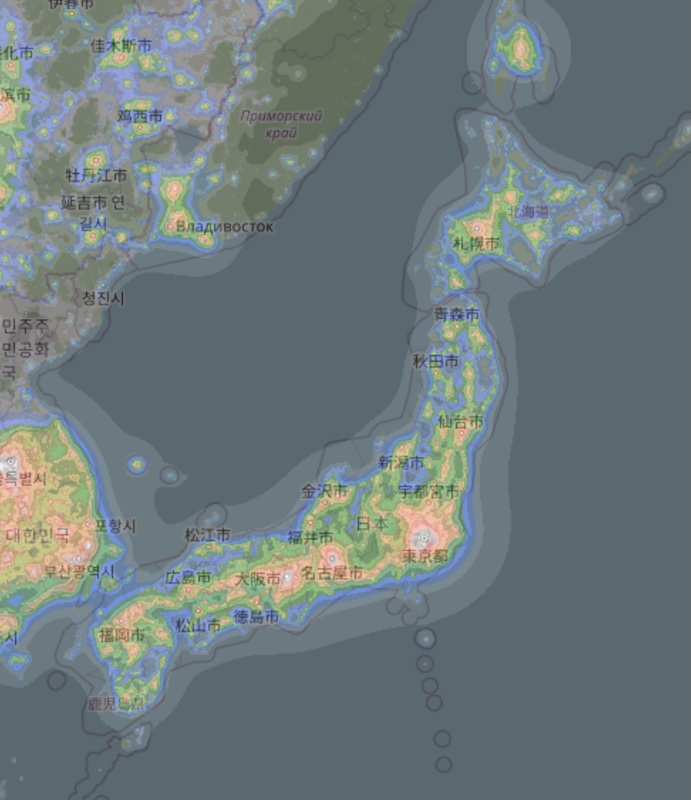
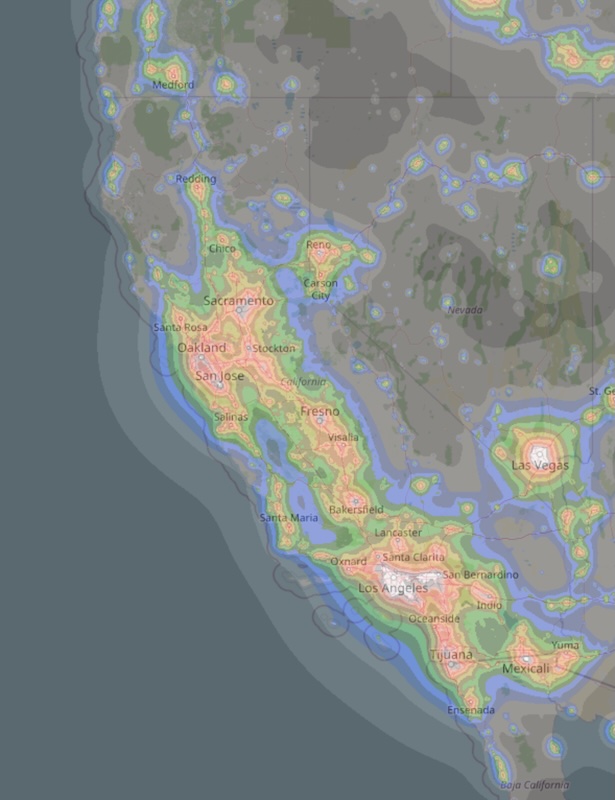
Light pollution maps of Japan and California. The darkest spots near Tokyo are mountain ranges north of Nikko (e.g. Oze National Park), and west of Nagano (the Chubu-Sangaku range, 中部山岳, centered at Tateyama), and the Izu Peninsula 伊豆半島. Dark spots in California include the Sierra Nevada and Coastal Ranges, the Klamath Mountains far north, and Death Valley / Mojave to the southeast.
1. Ginza Panorama Route / 蝶ヶ岳、大天井岳、燕岳
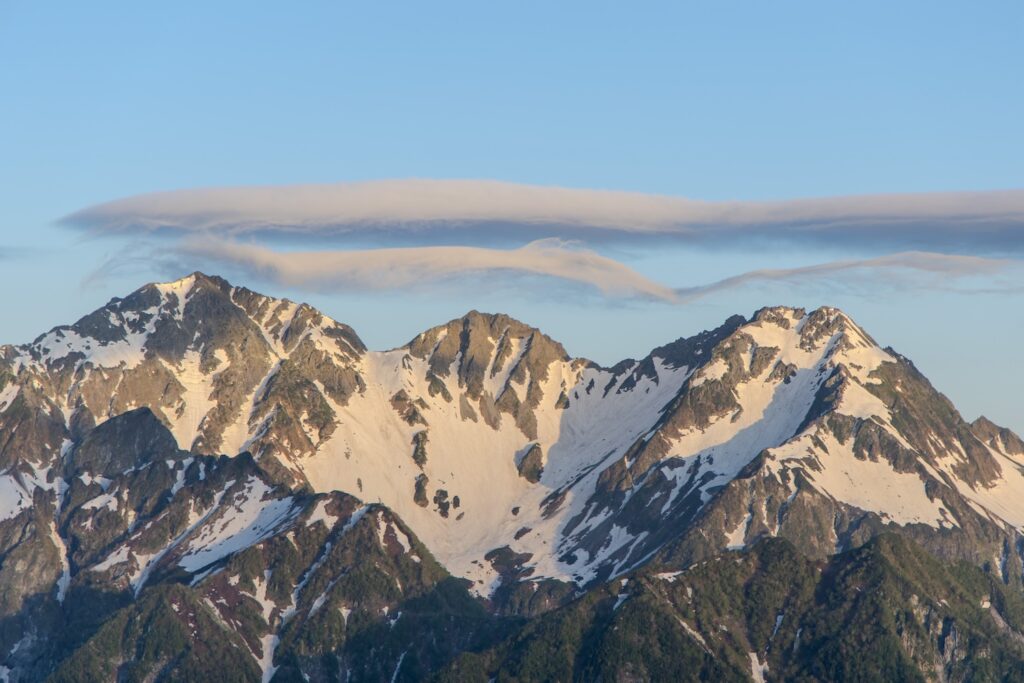
Tha Japan Alps, sandwiched between Tokyo, Nagoya, Olympic Nagano, and Kanazawa of the Golden Mochi, make a perfect 2-3 day outing in Japan. This area is famous for its skiing, but by the summer, the snow clears and the weather becomes mild enough for multi-day backpacking trips. Hikers can take advantage of the extensive mountain hut network to stay overnight without needing to bring tents and food. This is especially useful for casual hikers and foreign travelers who don’t want to worry about renting gear.
1.1 Itinerary
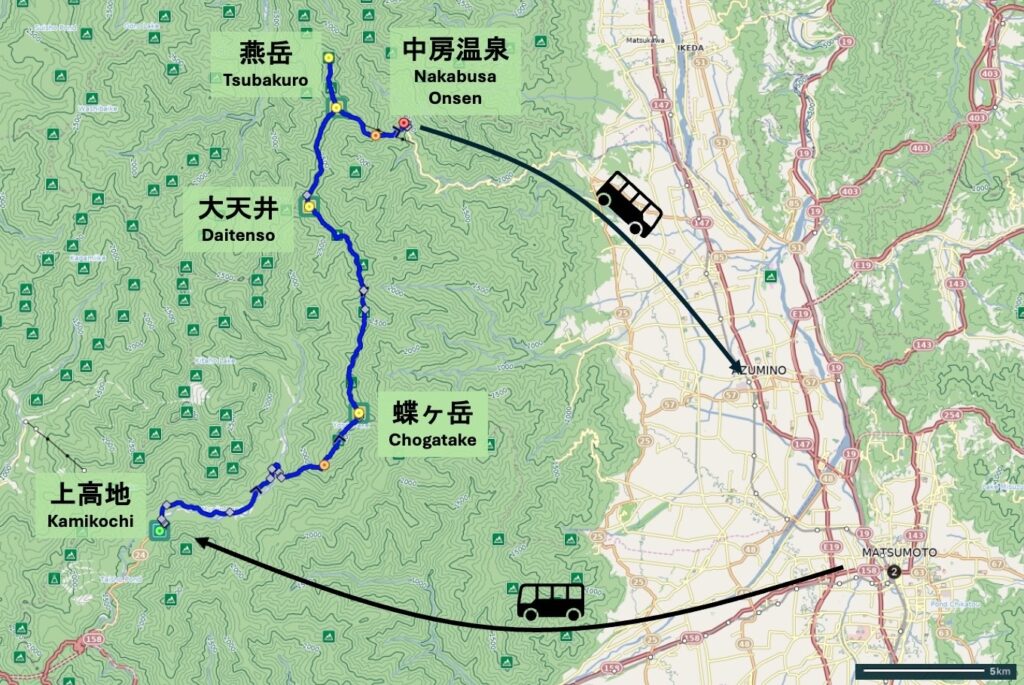
This itinerary is for the Ginza Panorama Route, which I hiked in 2025 in a side-trip from Tokyo.
- Start at Kamikochi (上高地). There is a direct bus from Tokyo operated by Alpico group (5 hours, 7-hour night bus also available). Book early as the night bus sells out fast. Alternatively, take a train to Matsumoto (松本), spend the night, and hop on the morning Kamikochi bus (about 1 hour), which gets to the trailhead by 7:00.
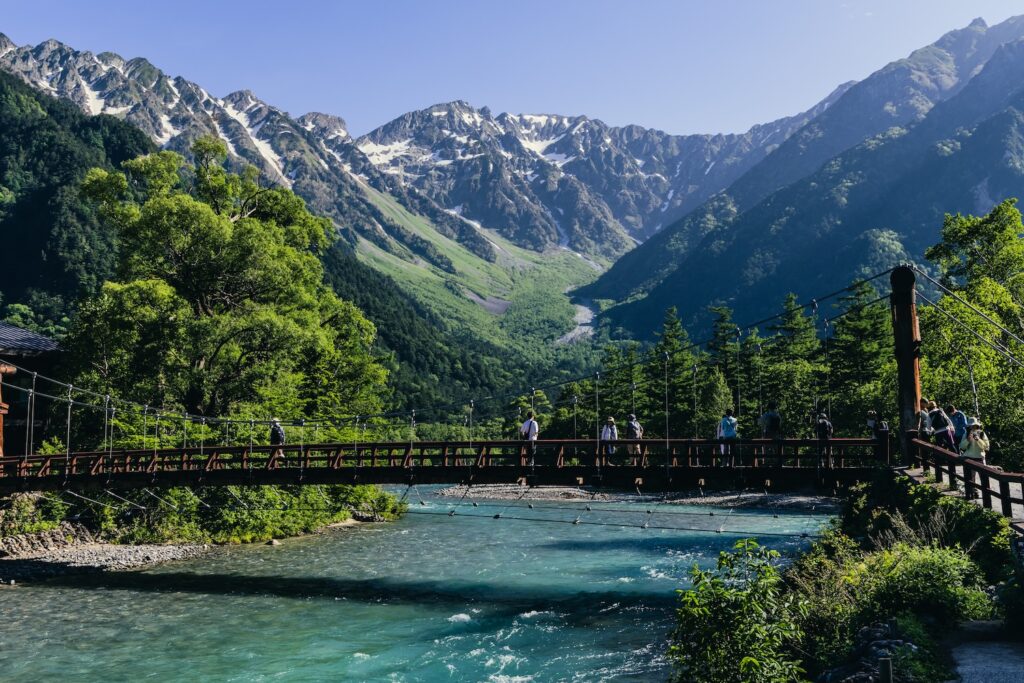
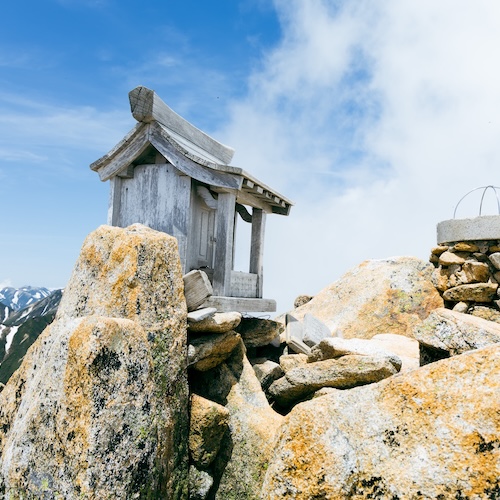
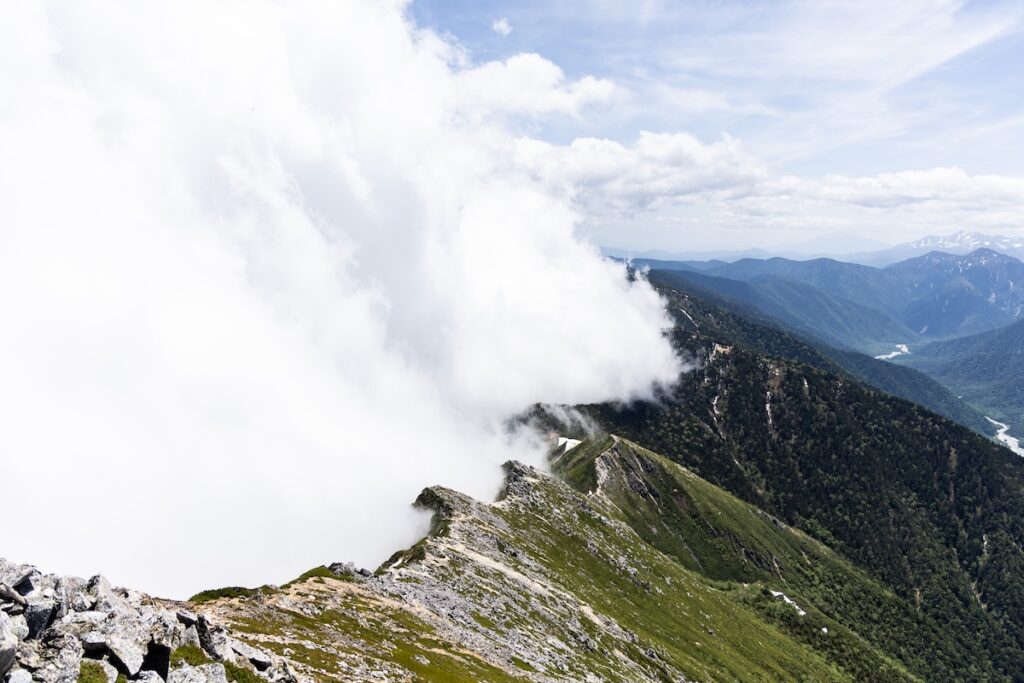
- (Day 1) Hike up to Chogatake (蝶ヶ岳). This is a long and steep climb that takes most of the day. By mid-afternoon, you will cross the tree line and enjoy 1-2 hours of fabulous scenery before reaching Chogatake Hut (蝶ヶ岳ヒュッテ). Stay overnight at the hut.
- (Day 2) Follow the ridge to Daitenso (大天井岳). It’s possible to break this up into two days, the first climbing up and down Mt. Jonen (常念岳), staying overnight at the neighboring hut (at the foot of the mountain, and barely below the treeline), followed by a climb up to Daitenso. But you can do it in a single 10-hour day if you must.
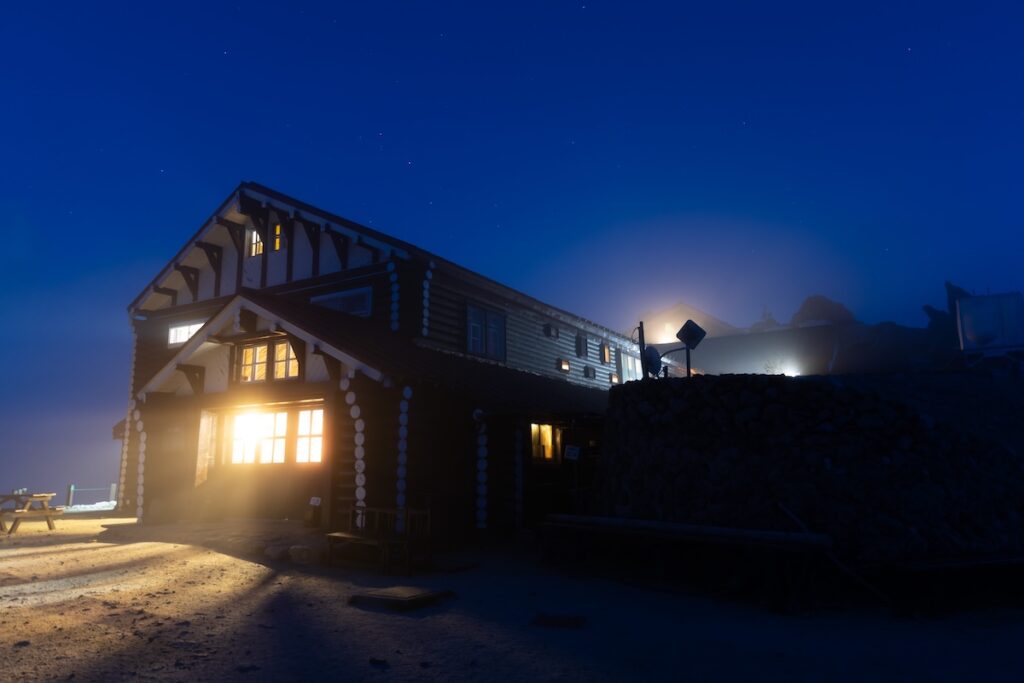
- (Day 3) Continue to Tsubakuro (燕岳). Stay overnight at the hut Enzanso (燕山荘); alternatively, since the hike is fairly short, continue all the way down to Nakabusa Onsen below, and stay the night there.
- Hike down from Enzanso (if not done the previous day) and take the bus back to Azumino, which connects to Matsumoto by rail.
A few notes about weather. Hiking season is June to October. May to June is rainy season in Japan. This means a reasonable probability of rain ruining a backpacking trip, and an even higher chance of clouds blocking any night sky views. Even when the weather forecast is calm and clear, the mountains follow a daily cloud cycle: at night, clouds and mist settles in the valleys creating an impression that the mountains are floating in a see of clouds (unkai/yunhai, 雲海). This leads to amazing sunrises. As the day progresses, the valley air warms up, creating currents that push the clouds up into the mountains. This can create those elegant cloud-capped mountain scenes, or it you’re unlucky it just blocks your view in a cloud. As a result, clear sunsets are less common, and the early night is a bad time for astronomy. Wait until later in the night, when the clouds sink back off the mountaintop, before trying any stargazing.
I hiked during rainy season, planned everything at the last minute (2 days before), and got extremely lucky: no rain, and 2/3 clear nights!
1.2 Gear
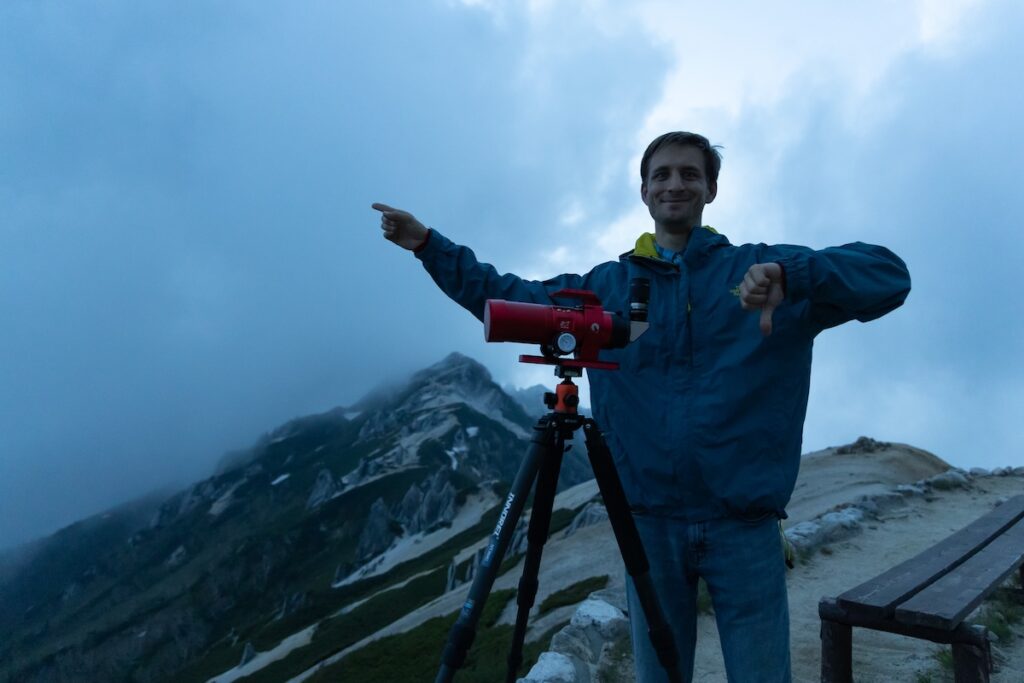
A camera + tripod + lens set will weigh you down 4 kg. Budget another 6 kg or so for a small telescope, tracking mount, power bank, etc. Also don’t forget some extra batteries for the camera. The weight adds up, and this is on top of food, clothes, and other hiking gear. You may find yourself carrying a second backpack.
The RedCat telescope doubles as a decent telephoto lens (250mm f/5) with excellent sharpness and contrast, and the most beautiful bokeh you’ll ever see. The downside is that it’s manual-focus, not image-stabilized, and needs a tripod for anything serious.
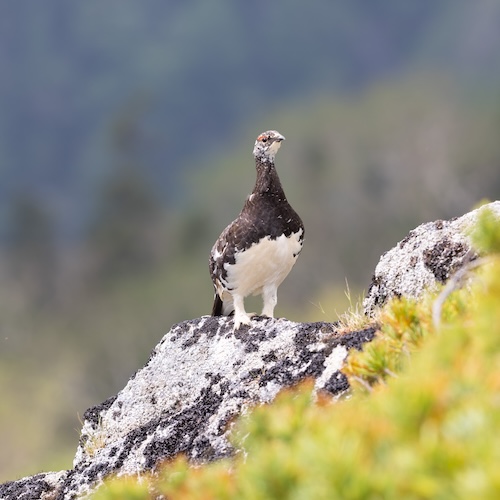
1.3 Day
1.4 Night
The first night was clear, and I spent it doing landscape astro. It was a waning half-moon, which means that the first half of the night is dark, and the moon rises around midnight. I used the 35mm Sigma to shoot frames for a Milky Way panorama, facing south:
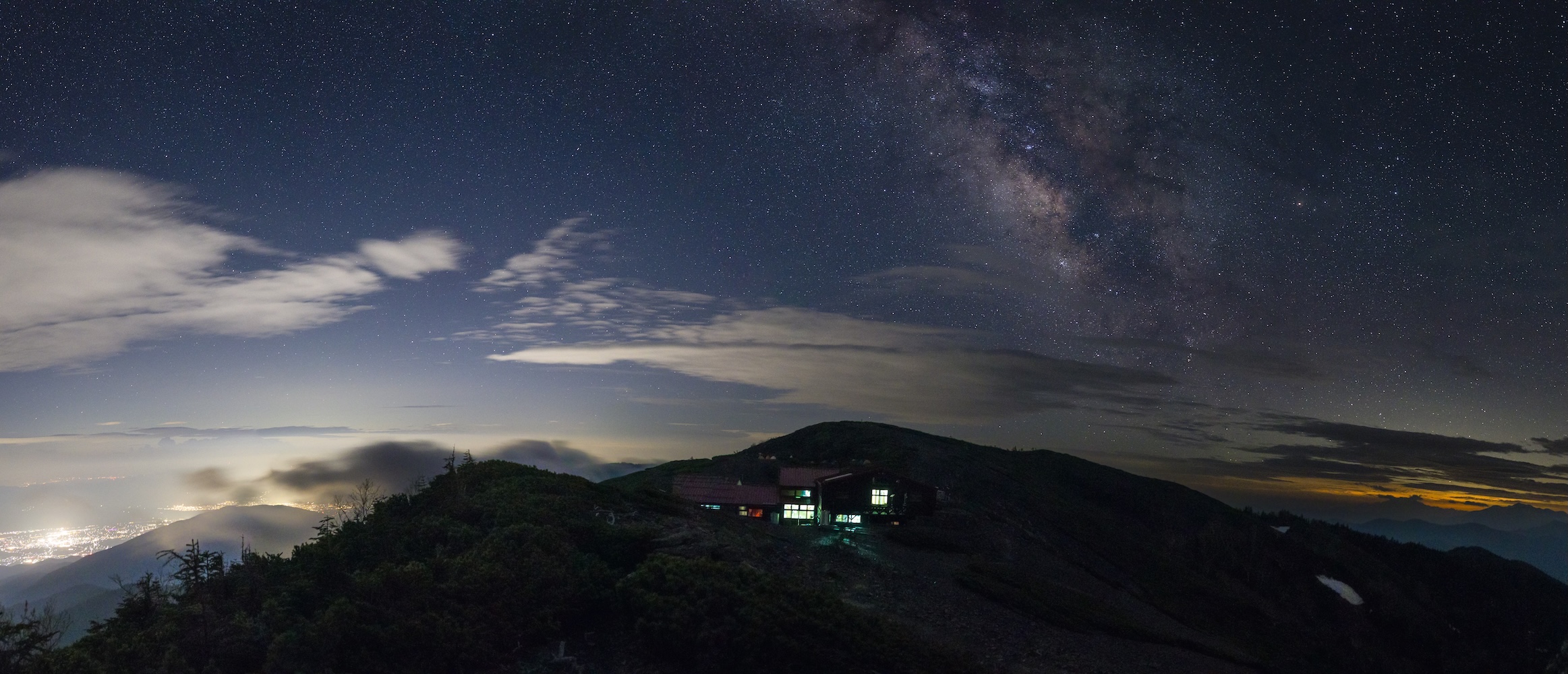
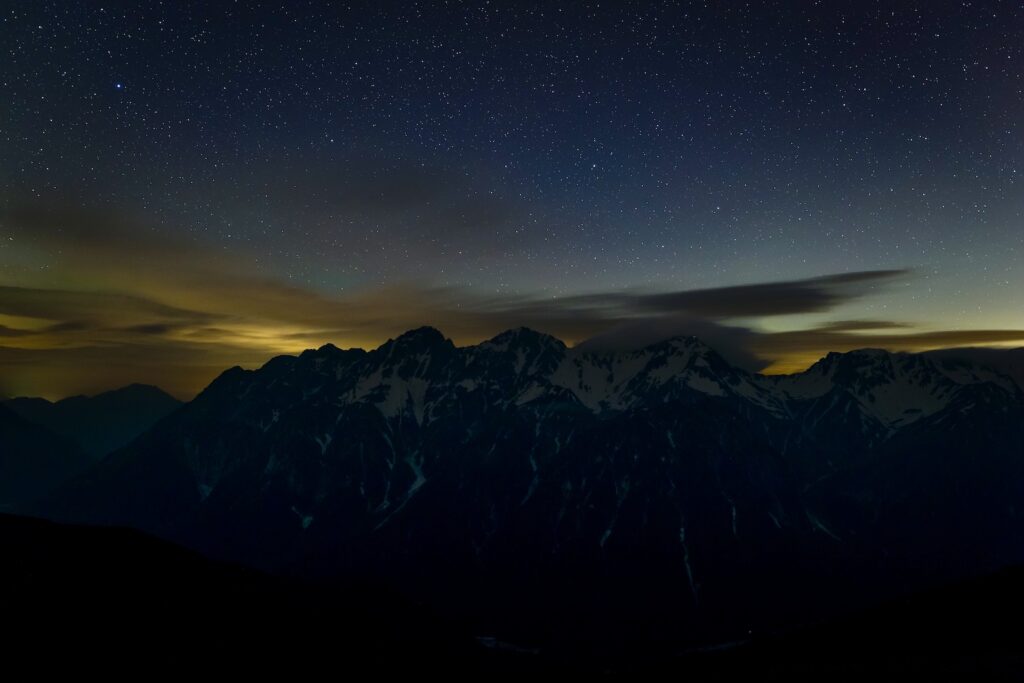
Obviously the Matsumoto suburbs to the southeast are brightening things up on the left! This would not be the best place to watch a Milky Way rise in the spring. But to the right, pristine darkness. Here’s a star-trail shot overlooking the Azusa river valley with the Hodaka mountains on the other side. Star trails got broken up a bit by passing clouds. Rainy season.
![{"shape": [4000, 6000, 3]}](https://photonhammer.blog/wp-content/uploads/2026/01/g4-2-1024x683.jpeg "Mountains and Astrophotography")
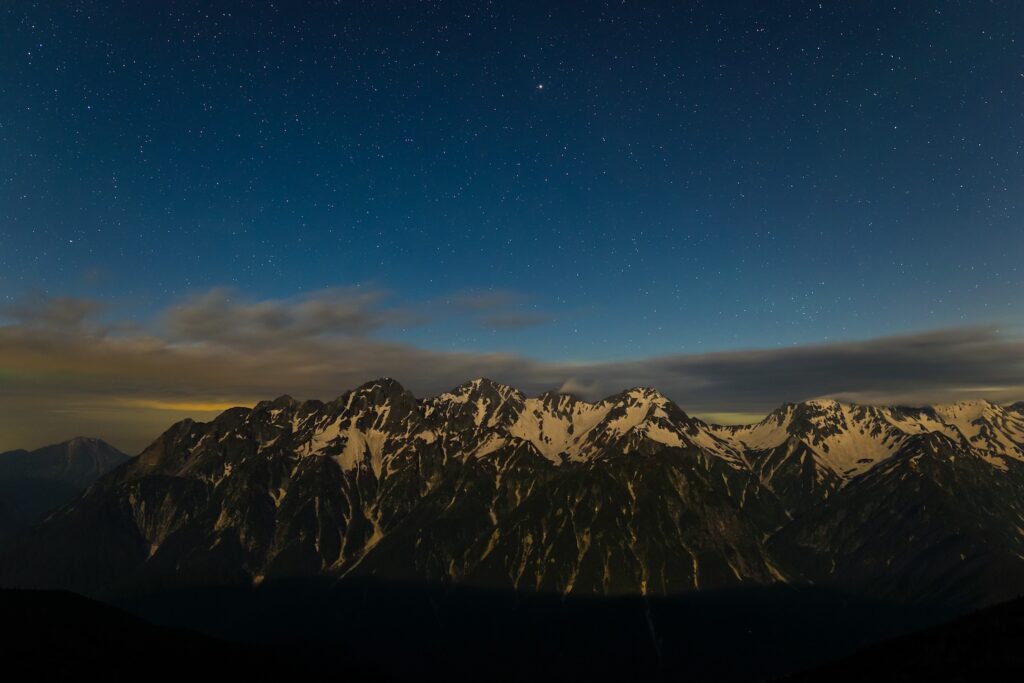
By now the moon was up, lighting the Hodaka mountains in a brilliant silver glow. These mountains are a lot higher and still have snow on them. There is another trail that follows that ridge; it opens later in the season and is technically much more difficult.
The second night was cloudy and windy. The third night started out cloudy…
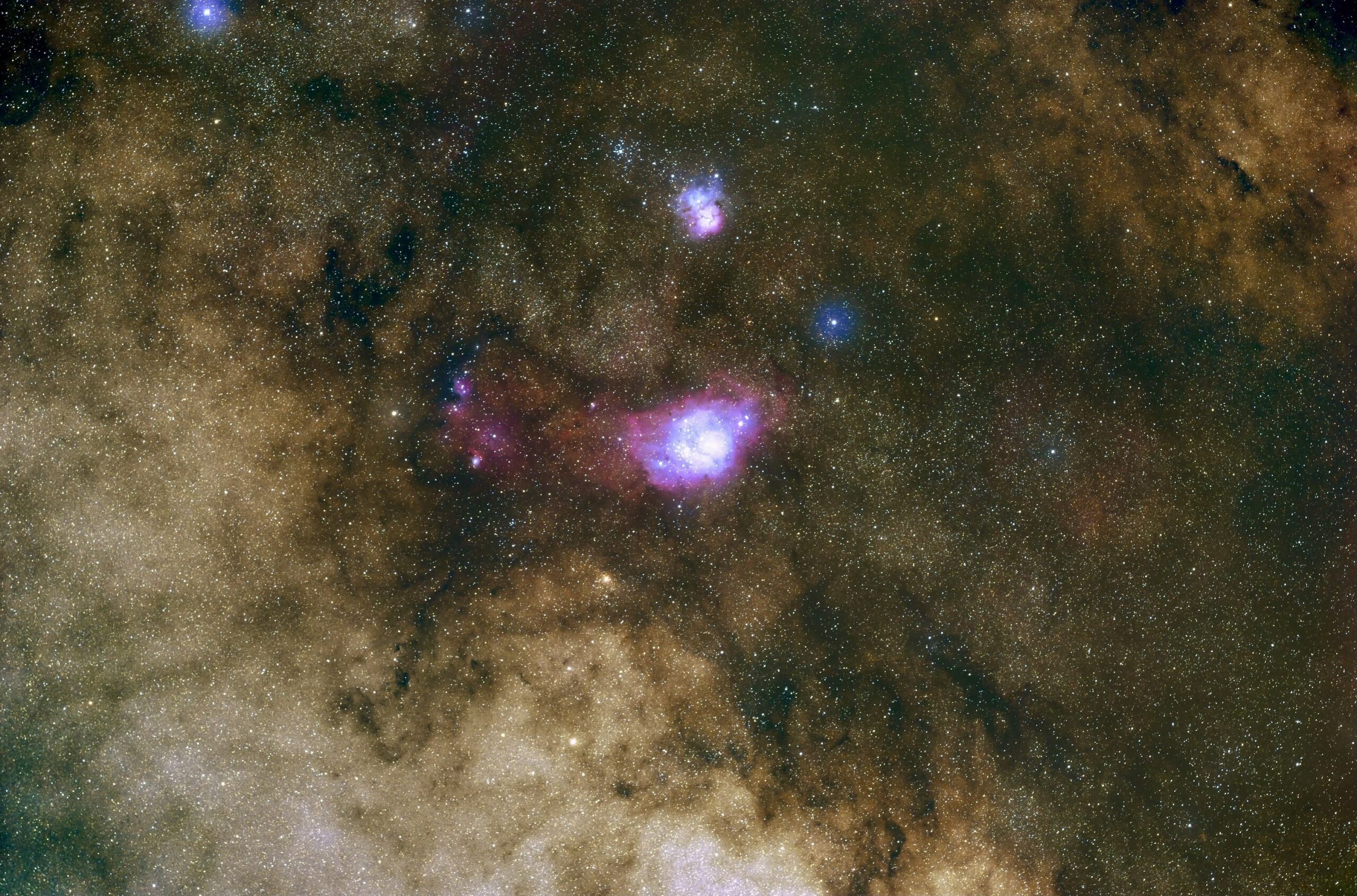
But it cleared up by midnight. I went outside, set up the RedCat on the star tracker, pointed it south at Sagittarius, and got a solid 3 hours of image data. With the 9º FOV, you can easily capture the Lagoon Nebula, Trifid Nebula, and Chinese Dragon Nebula in a single frame!
2. Great Basin
The 2025 Summer of Astronomy Expedition started with three mountain parks: Great Basin, Lassen, and Crater Lake. I hit Great Basin only a couple days after the full moon, and the clouds were finicky, leading to only about 3 hours of telescope time in 3 whole nights. That was only enough for a mediocre image of the Eagle Nebula (not shown).
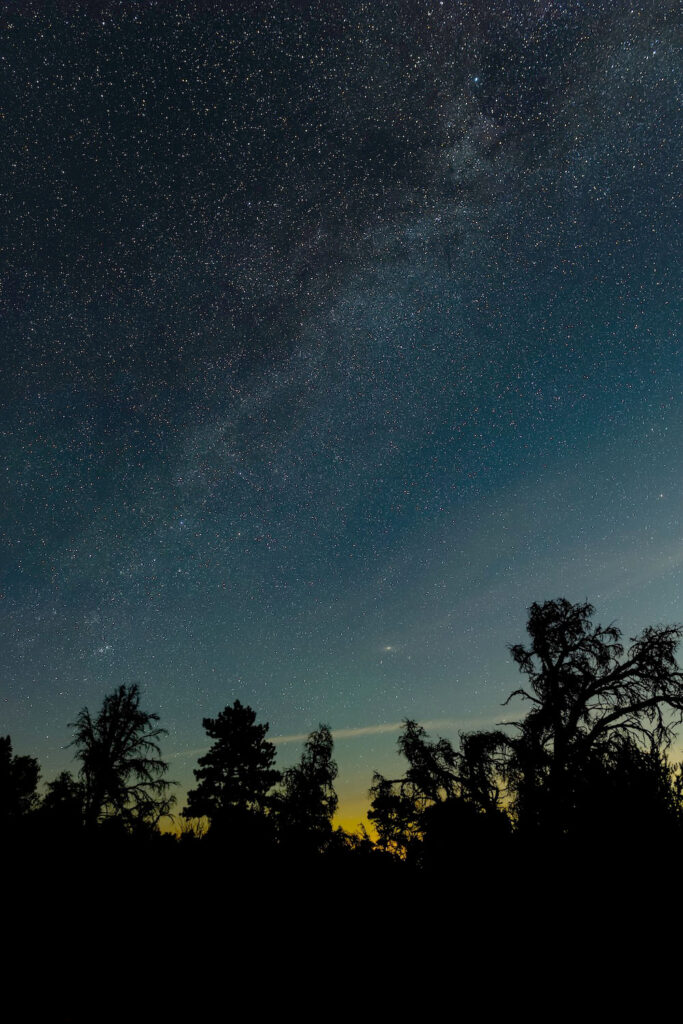
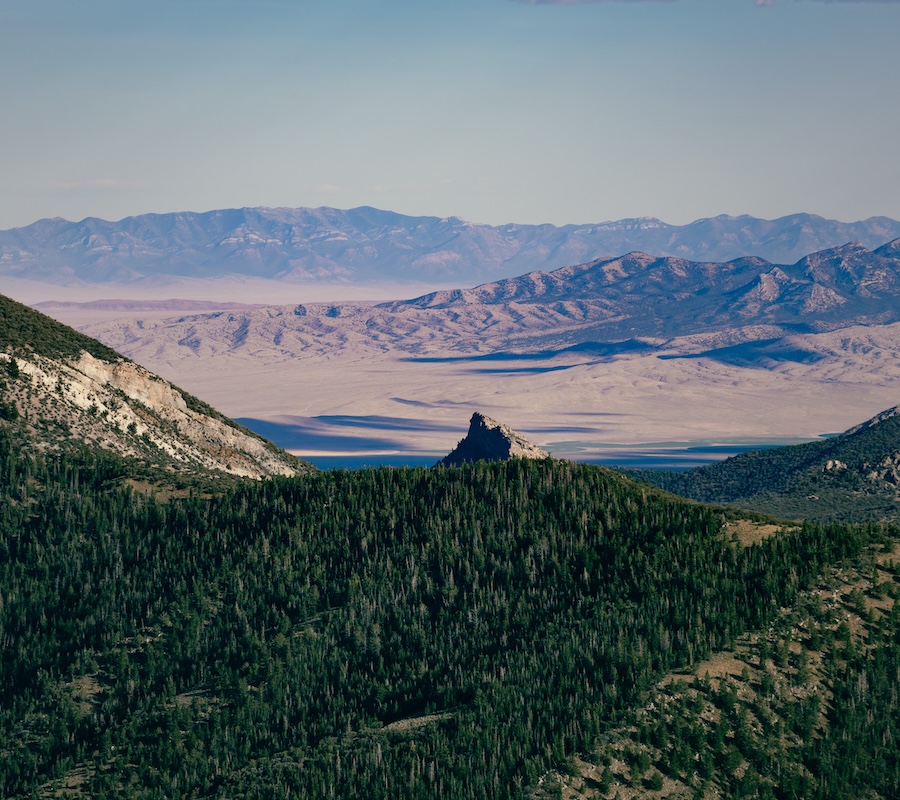
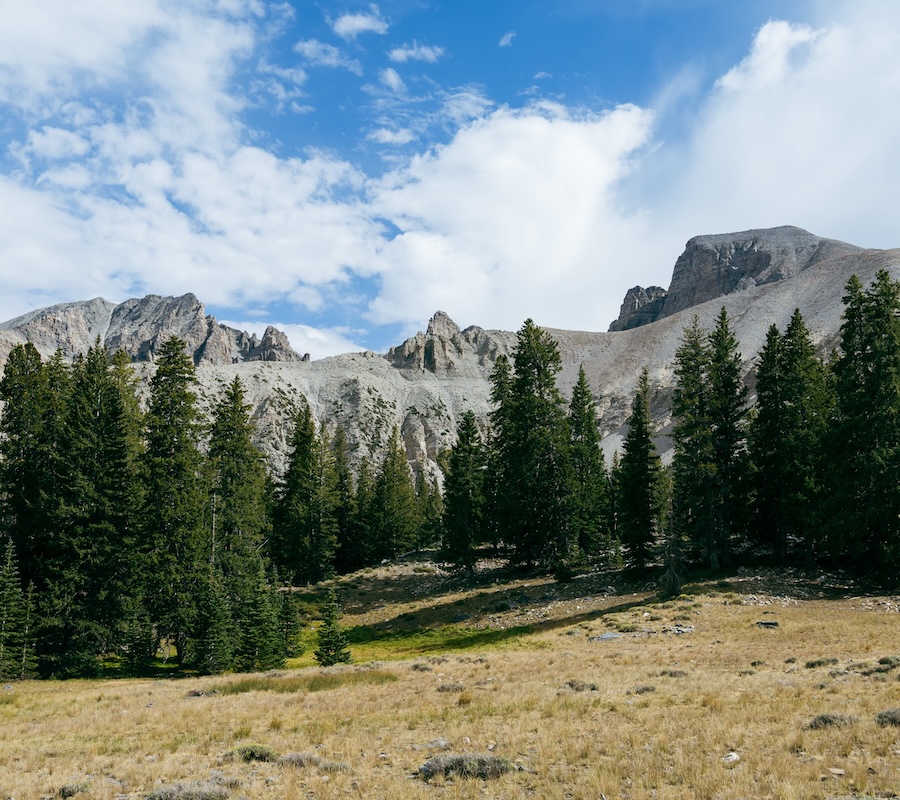
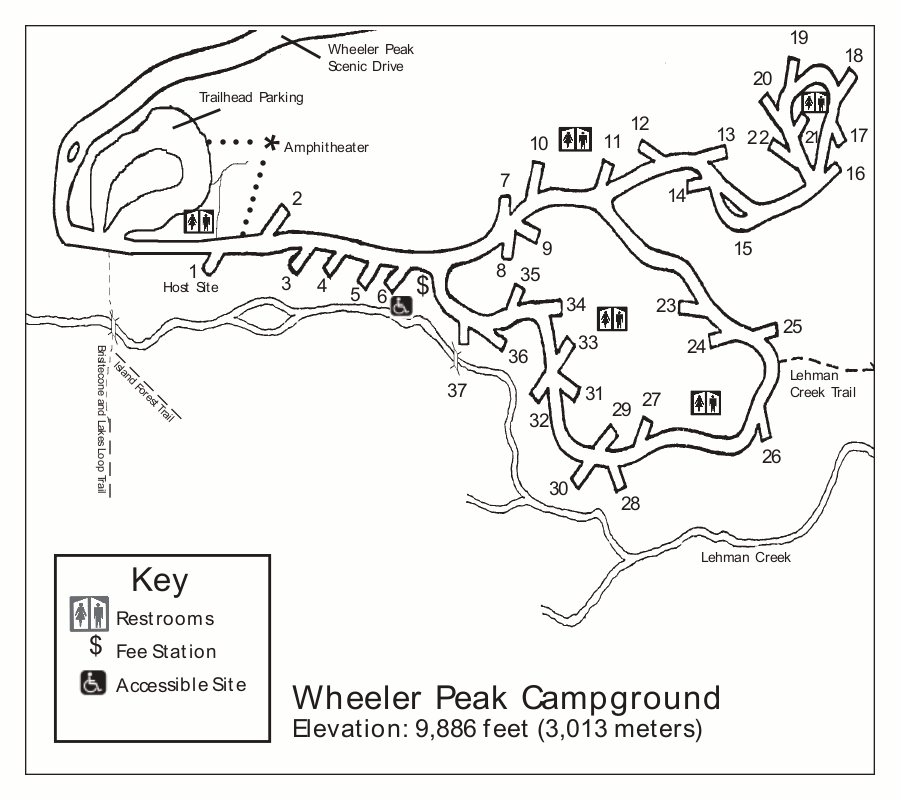
If the weather is clear, Wheeler Peak Campground is a great spot for astrophotography (I went but it was cloudy). There are multiple close-up views of Wheeler Peak, which make a great foreground. The campsites in the large loop (especially 24-31) are also located near a meadow, giving a wide-open field of view to set up a telescope.
3. Lassen
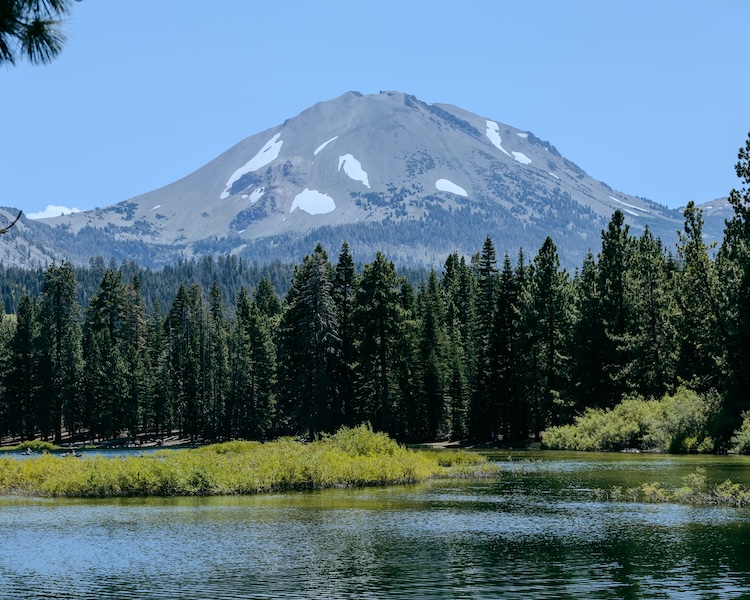
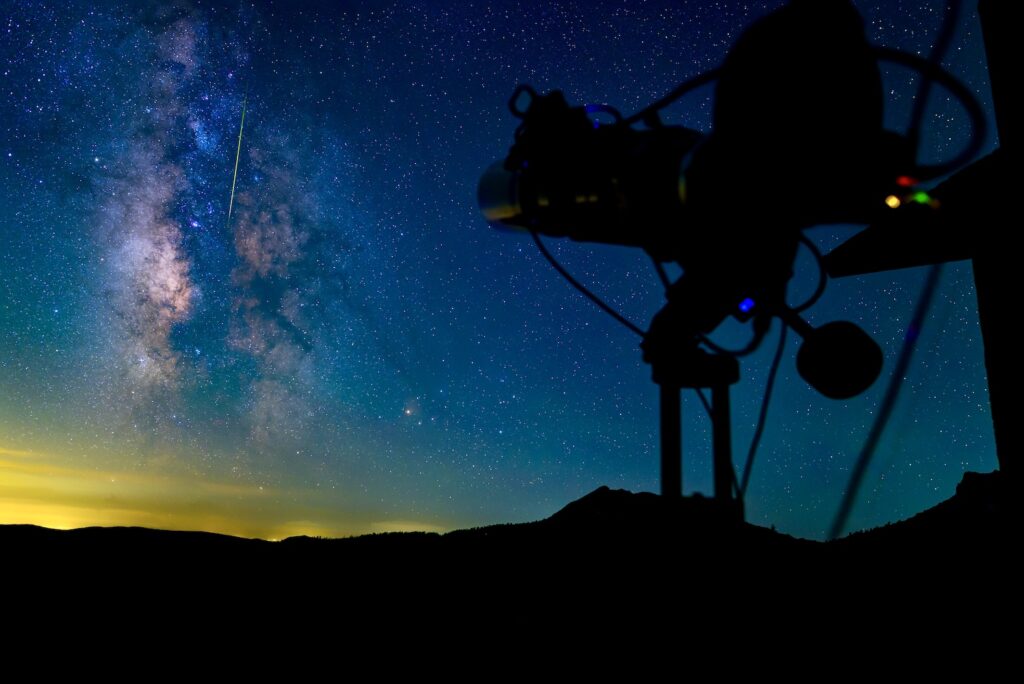
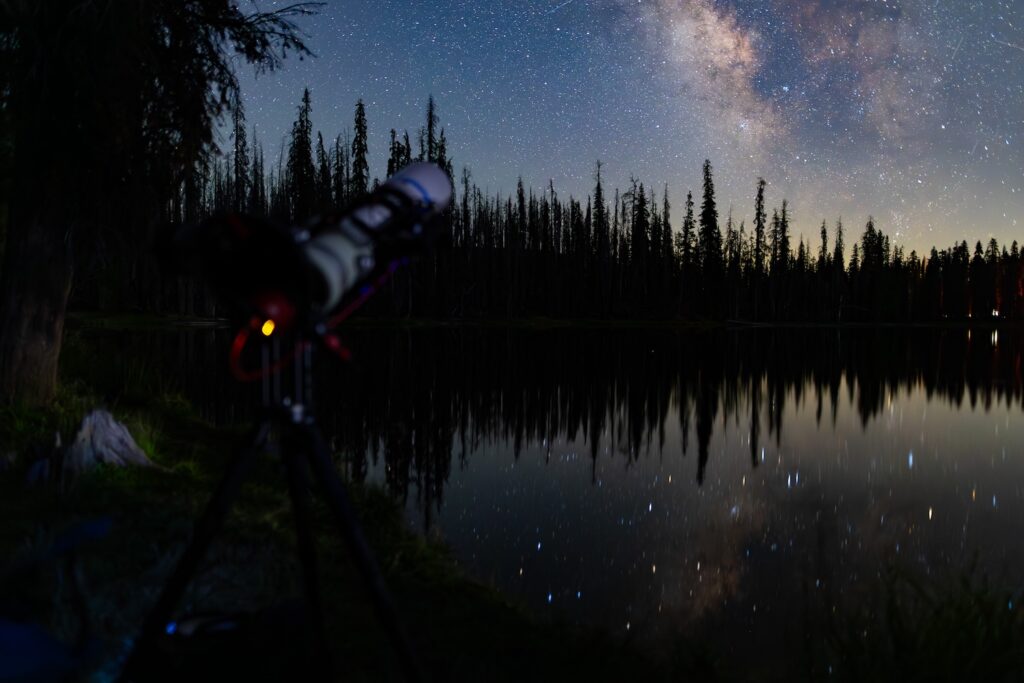
In a Bortle 2 area, Lassen Volcanic National Park is one of the darkest parks in California. Highway CA-89 bisects the park and is open to traffic during the summer, peaking at 8,500 ft (Lassen Peak itself is 10,300 ft). This makes Lassen a good road-accessible mountain stargazing spot. During two nights camping at Lassen, I gathered 9 hours of LRGB+Ha data on the Lagoon Nebula using the FSQ. Given the larger telescope and longer integration time, this gave me 10x more data on this target than my outing at Tsubakuro (albeit with a narrower field of view).
Night 1
![{"shape": [4000, 6000, 3]}](https://photonhammer.blog/wp-content/uploads/2026/01/l1-1-1024x683.jpeg "Mountains and Astrophotography")
Night 2
![{"shape": [4000, 6000, 3]}](https://photonhammer.blog/wp-content/uploads/2026/01/l3-2-3-1024x683.jpeg "Mountains and Astrophotography")
The Image
The full-frame Player One Zeus is an amazing camera that lets you capture very wide fields of view. It gives you 2x the area of an APS-C camera like the ZWO ASI2600, 4x that of micro-4/3rds, and 12x that of the tiny but popular (in astrophotography) IMX585 sensor. This gives a lot of flexibility in capturing larger objects, or multiple objects in a single run. Here we have three: the Lagoon Nebula, the Trifid Nebula, and the Chinese Dragon Nebula.
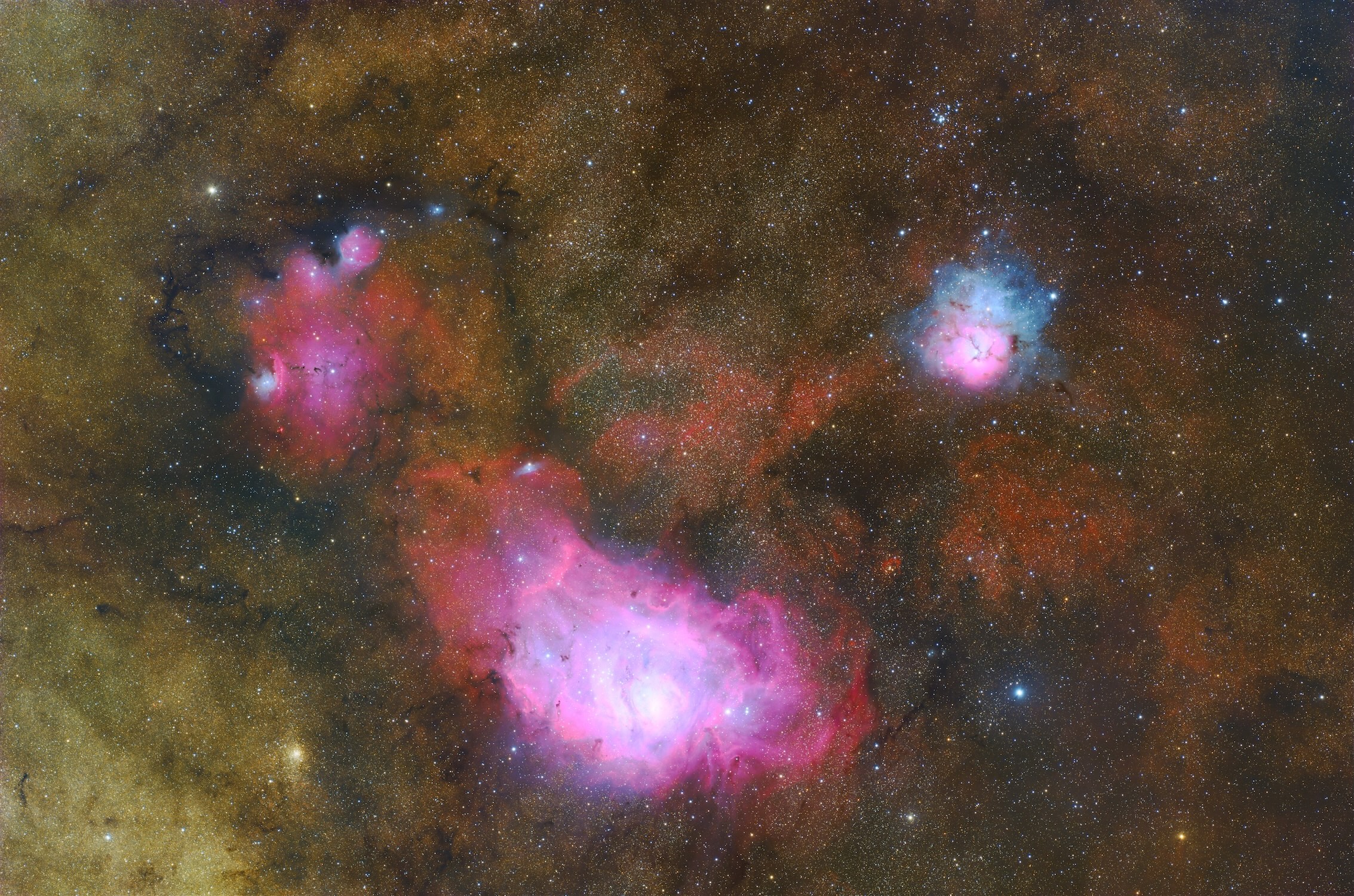
It can be difficult to postprocess such a complex scene given the different elements:
- Bright emission nebula (Lagoon, M8)
- Faint emission nebula (Chinese Dragon, LBN 28)
- A nebula with both emission and reflection (Trifid, M20)
- Globular cluster (Starfish Cluster, NGC 6544)
- Parts of the Milky Way core
- A couple of bright stars
- Faint Ha nebulosity between objects
Each of these objects wants its own postprocessing settings, to bring out its detail in the best way. But these settings conflict with each other, and a workflow that does well for one object can leave another over-saturated, messy, or underexposed. The above image is a pretty “natural” LRGB representation, with a little extra red added from the Ha channel. But if we crop the image to and edit each object separately, we can go a lot further.
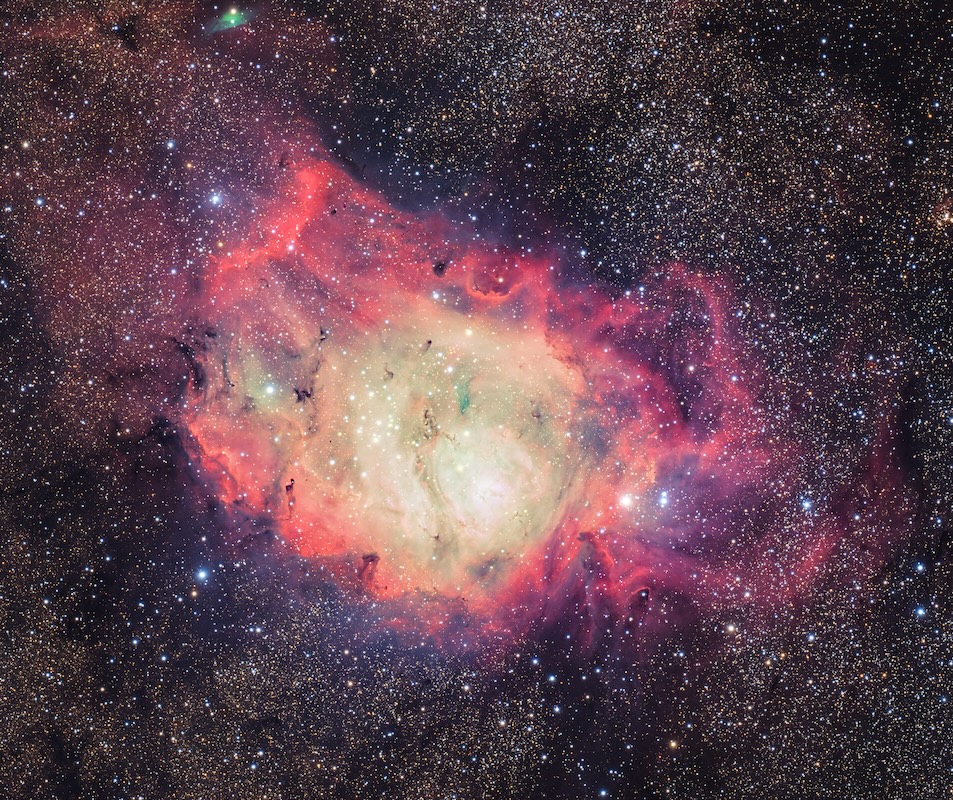
Let’s start with the Lagoon Nebula. I prefer a “warm” look that paints the interior yellow, surrounded by a red shell.
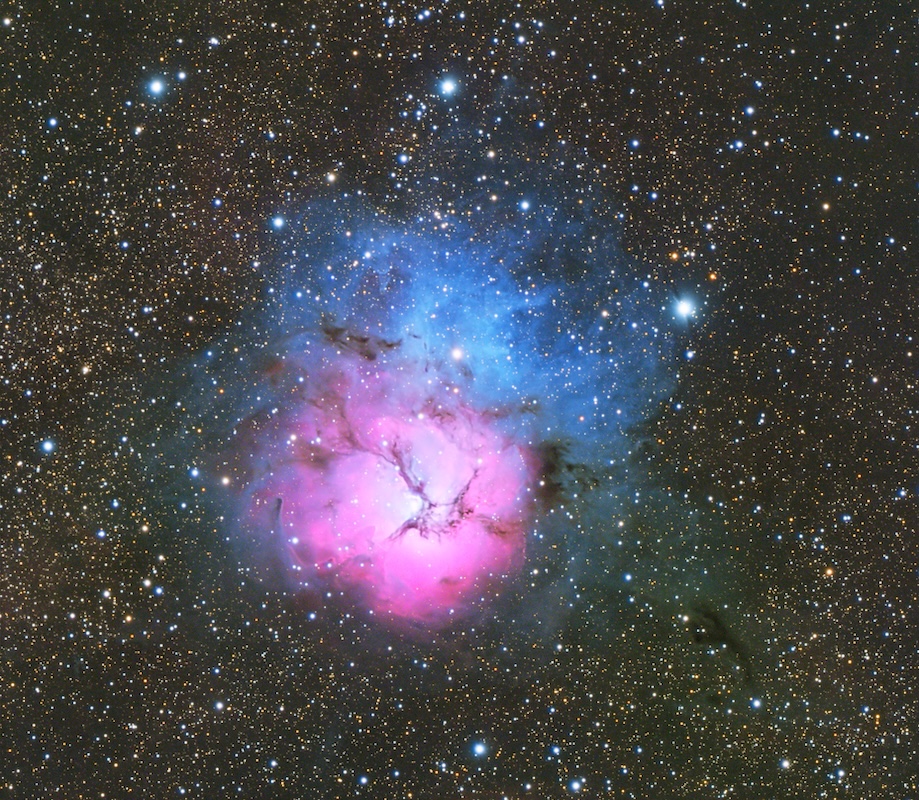
For the Trifid Nebula, I prefer a “cool” look that saturates the blue reflection nebula, creating a pleasing contrast between blue and red.
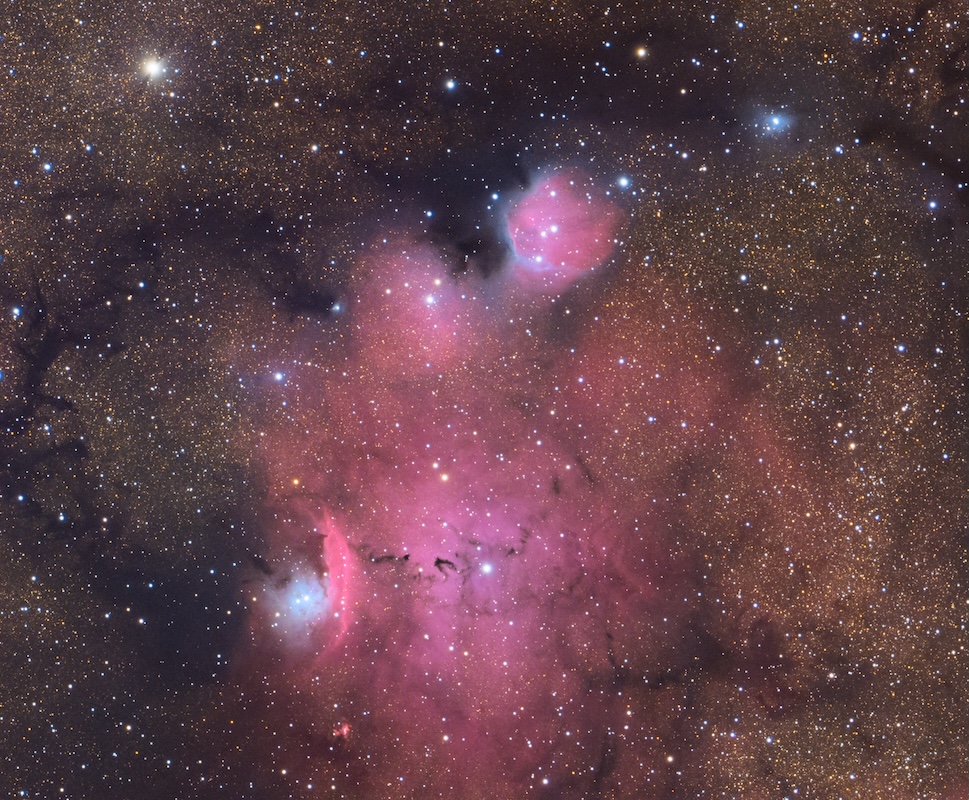
And for the Chinese Dragon Nebula, I tried multiple approaches to bring out more detail, but nothing stuck. So I defaulted to a more natural RGB representation, similar to the original image.
As you can see, compared to the Ginza Panorama expedition with the RedCat 51, we could pull so much more detail out of the same object! This mainly comes down to collecting more light. I imaged for longer, using a bigger telescope, with a more efficient filtering technique, on a higher-efficiency astro camera. All these things add up.
Ha, and I didn’t know this at the time, but this is the exact same object (and almost the same framing) as the first published image from the NSF-DOE Vera C. Rubin Telescope (formerly LSST)!
4. Crater Lake
The last mountain I wish to highlight is Crater Lake, and like Lassen, this one is drivable. Although the lake is very busy during the daytime, it clears out very quickly after dusk. Camping is prohibited, but there is no rule against staying out until (say) 2:00 watching the stars.
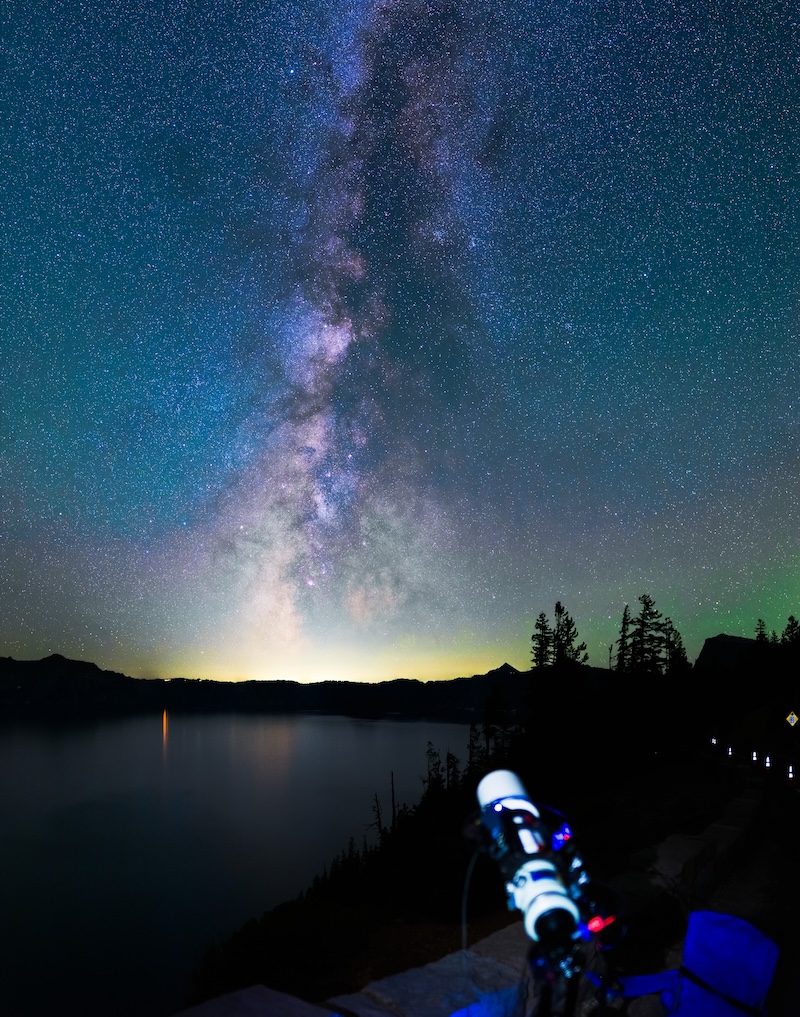
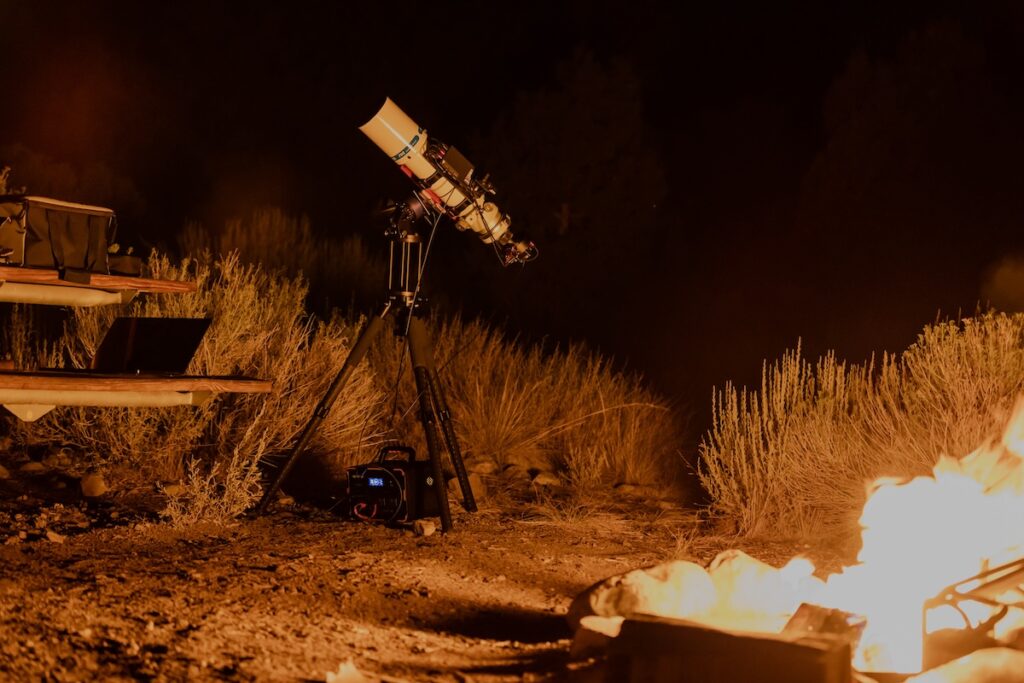
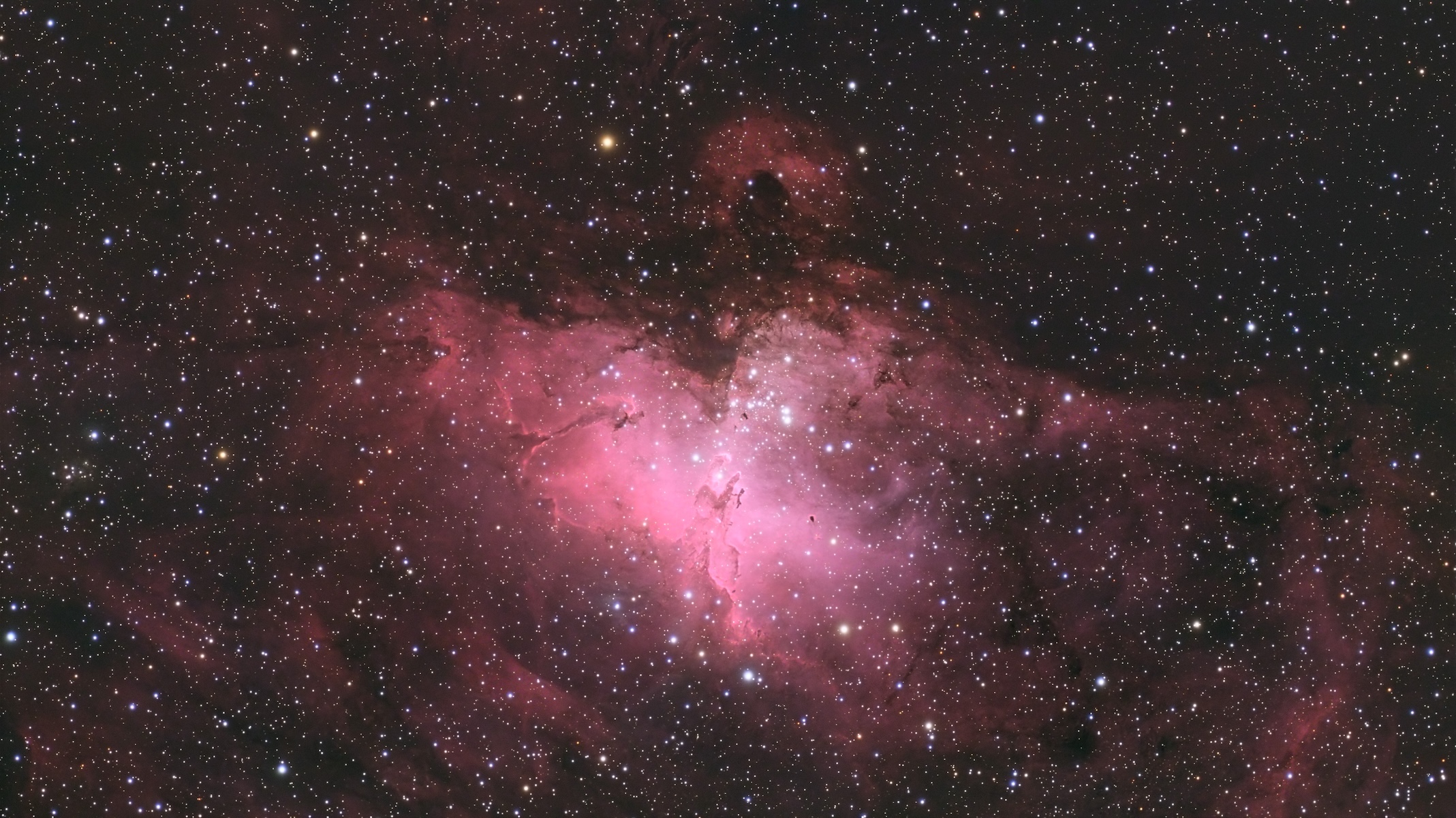
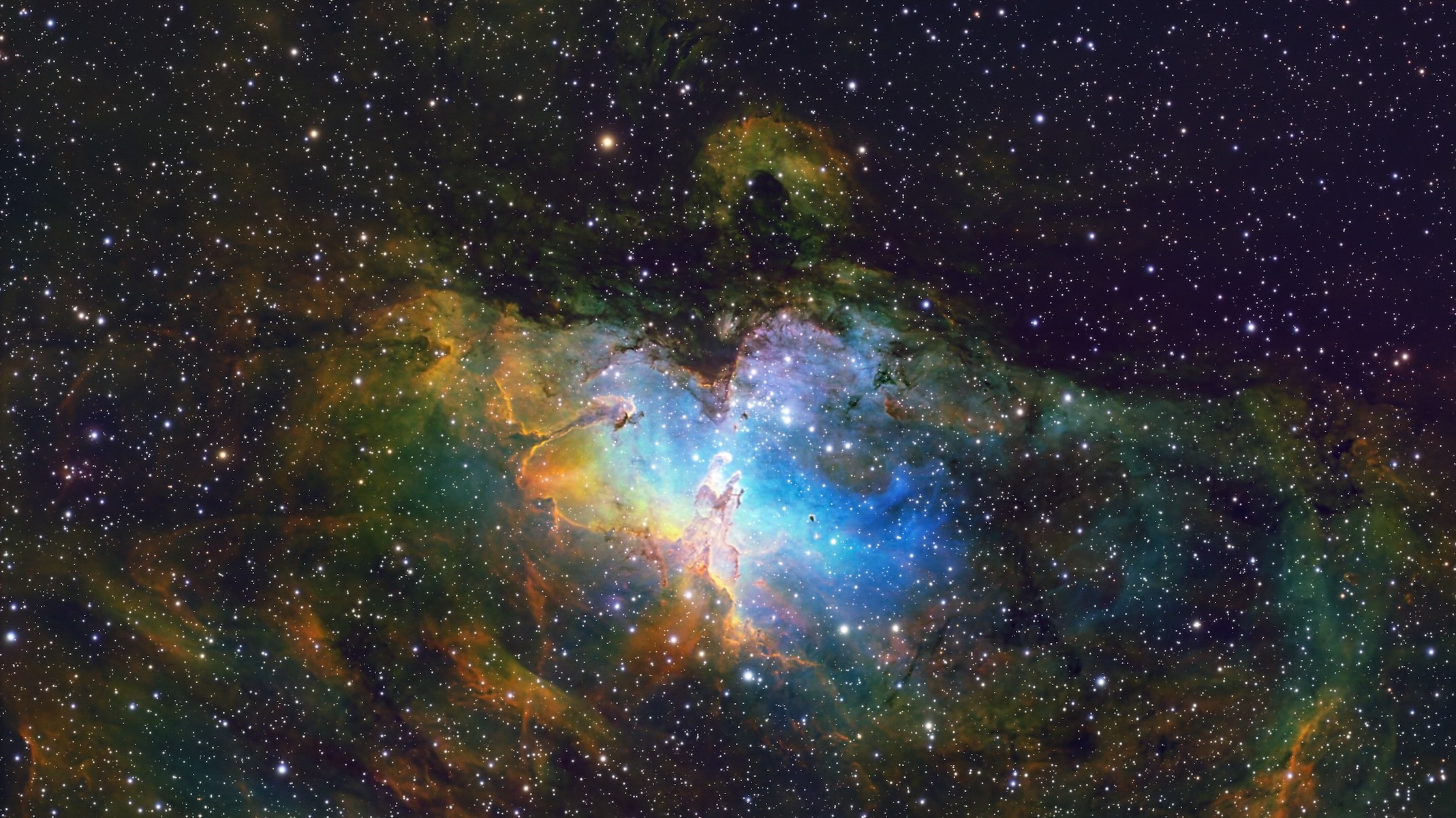
Looking very closely, you can see that the telescope is pointed at the Eagle Nebula, also in the heart of the galaxy core, but about 10 degrees north of the Lagoon Nebula. Combined with the Great Basin session, this gave me enough data to make a satisfactory image.
Eagle Nebula in Natural Colors (LRGB)
Eagle Nebula in Narrowband (SHO)
Eagle Nebula, SHO, starless
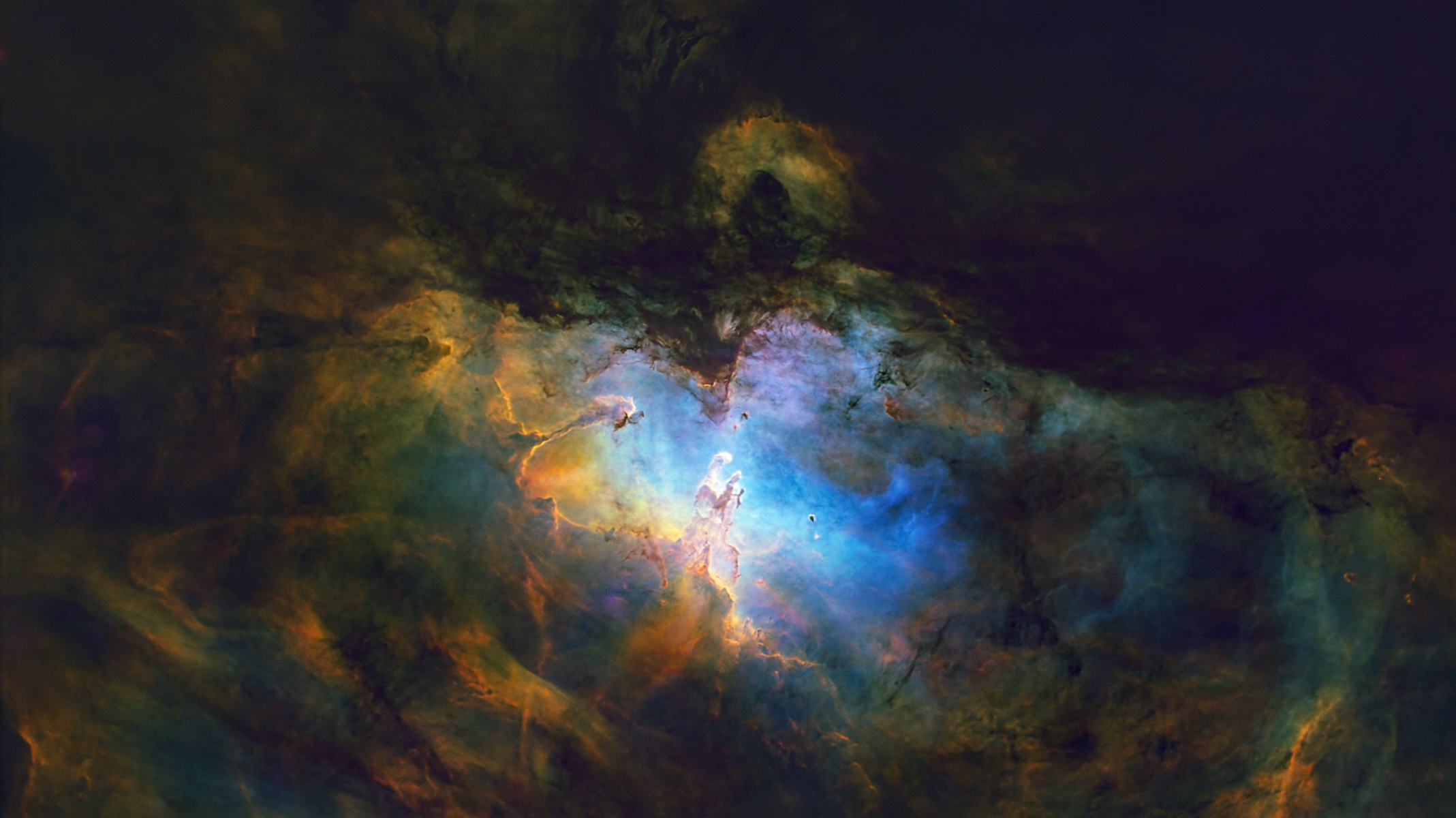
At the center of this nebula, you can see the Pillars of Creation, clouds of dust obscuring a stellar nursery, captured by the Hubble Space Telescope in one of NASA’s most iconic images of all time. As young stars form in this cosmic eagle’s nest, their strong solar winds will push away the dust, and a few thousand years the Pillars will be no more, preserved only in the memory of those who knew them.